 Add to Chrome
 Add to Firefox
 Add to Edge
What are the Right Symmetries for Formal Theorem Proving?
May 21, 2026
Formal theorem provers based on large language models (LLMs) are highly sensitive to superficial variations in problem representation: semantically equivalent statements can exhibit drastically different proof success rates, revealing a failure to respect structural symmetries inherent in formal mathematics. This raises a central question: what are the right symmetries for formal theorem proving? We introduce rewriting categories, a category-theoretic framework capturing the compositional, generally non-invertible transformations induced by proof tactics, and use it to formalize two symmetry notions: proof equivariance, governing how proof distributions transform under rewrites, and success invariance (i.e., invariance of success probability), requiring equivalent statements to be solved with the same probability. We observe that state-based next-tactic provers naturally satisfy proof equivariance by operating on proof states. In contrast, state-of-the-art LLM-based provers satisfy neither property, exhibiting large performance variation across equivalent formulations. To mitigate this, we propose test-time methods that aggregate over equivalent rewritings of the input, showing theoretically that they recover success invariance in the sampling limit, and empirically, that they improve robustness and performance under fixed inference budgets. Our results highlight symmetry as a key missing inductive bias in LLM-based theorem proving and suggest test-time computation as a practical route to approximate it.

MacroGuide: Topological Guidance for Macrocycle Generation
Feb 16, 2026Macrocycles are ring-shaped molecules that offer a promising alternative to small-molecule drugs due to their enhanced selectivity and binding affinity against difficult targets. Despite their chemical value, they remain underexplored in generative modeling, likely owing to their scarcity in public datasets and the challenges of enforcing topological constraints in standard deep generative models. We introduce MacroGuide: Topological Guidance for Macrocycle Generation, a diffusion guidance mechanism that uses Persistent Homology to steer the sampling of pretrained molecular generative models toward the generation of macrocycles, in both unconditional and conditional (protein pocket) settings. At each denoising step, MacroGuide constructs a Vietoris-Rips complex from atomic positions and promotes ring formation by optimizing persistent homology features. Empirically, applying MacroGuide to pretrained diffusion models increases macrocycle generation rates from 1% to 99%, while matching or exceeding state-of-the-art performance on key quality metrics such as chemical validity, diversity, and PoseBusters checks.
Categorical Flow Maps
Feb 12, 2026We introduce Categorical Flow Maps, a flow-matching method for accelerated few-step generation of categorical data via self-distillation. Building on recent variational formulations of flow matching and the broader trend towards accelerated inference in diffusion and flow-based models, we define a flow map towards the simplex that transports probability mass toward a predicted endpoint, yielding a parametrisation that naturally constrains model predictions. Since our trajectories are continuous rather than discrete, Categorical Flow Maps can be trained with existing distillation techniques, as well as a new objective based on endpoint consistency. This continuous formulation also automatically unlocks test-time inference: we can directly reuse existing guidance and reweighting techniques in the categorical setting to steer sampling toward downstream objectives. Empirically, we achieve state-of-the-art few-step results on images, molecular graphs, and text, with strong performance even in single-step generation.
Curly Flow Matching for Learning Non-gradient Field Dynamics
Oct 30, 2025Modeling the transport dynamics of natural processes from population-level observations is a ubiquitous problem in the natural sciences. Such models rely on key assumptions about the underlying process in order to enable faithful learning of governing dynamics that mimic the actual system behavior. The de facto assumption in current approaches relies on the principle of least action that results in gradient field dynamics and leads to trajectories minimizing an energy functional between two probability measures. However, many real-world systems, such as cell cycles in single-cell RNA, are known to exhibit non-gradient, periodic behavior, which fundamentally cannot be captured by current state-of-the-art methods such as flow and bridge matching. In this paper, we introduce Curly Flow Matching (Curly-FM), a novel approach that is capable of learning non-gradient field dynamics by designing and solving a Schr\"odinger bridge problem with a non-zero drift reference process -- in stark contrast to typical zero-drift reference processes -- which is constructed using inferred velocities in addition to population snapshot data. We showcase Curly-FM by solving the trajectory inference problems for single cells, computational fluid dynamics, and ocean currents with approximate velocities. We demonstrate that Curly-FM can learn trajectories that better match both the reference process and population marginals. Curly-FM expands flow matching models beyond the modeling of populations and towards the modeling of known periodic behavior in physical systems. Our code repository is accessible at: https://github.com/kpetrovicc/curly-flow-matching.git
Flock: A Knowledge Graph Foundation Model via Learning on Random Walks
Oct 01, 2025We study the problem of zero-shot link prediction on knowledge graphs (KGs), which requires models to generalize over novel entities and novel relations. Knowledge graph foundation models (KGFMs) address this task by enforcing equivariance over both nodes and relations, learning from structural properties of nodes and relations, which are then transferable to novel graphs with similar structural properties. However, the conventional notion of deterministic equivariance imposes inherent limits on the expressive power of KGFMs, preventing them from distinguishing structurally similar but semantically distinct relations. To overcome this limitation, we introduce probabilistic node-relation equivariance, which preserves equivariance in distribution while incorporating a principled randomization to break symmetries during inference. Building on this principle, we present Flock, a KGFM that iteratively samples random walks, encodes them into sequences via a recording protocol, embeds them with a sequence model, and aggregates representations of nodes and relations via learned pooling. Crucially, Flock respects probabilistic node-relation equivariance and is a universal approximator for isomorphism-invariant link-level functions over KGs. Empirically, Flock perfectly solves our new diagnostic dataset Petals where current KGFMs fail, and achieves state-of-the-art performances on entity- and relation prediction tasks on 54 KGs from diverse domains.
Of Graphs and Tables: Zero-Shot Node Classification with Tabular Foundation Models
Sep 08, 2025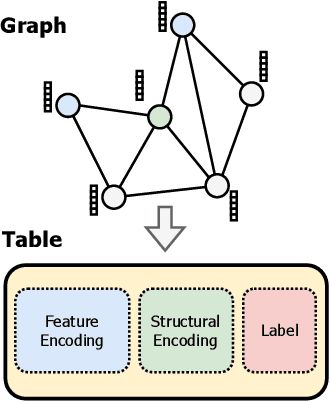
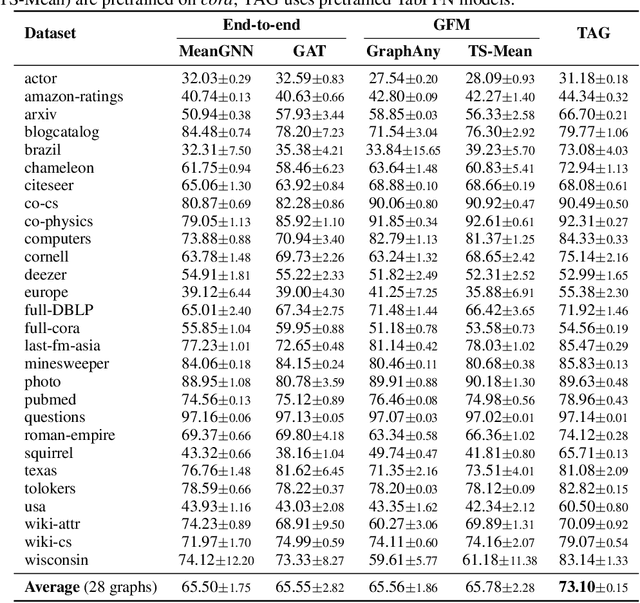
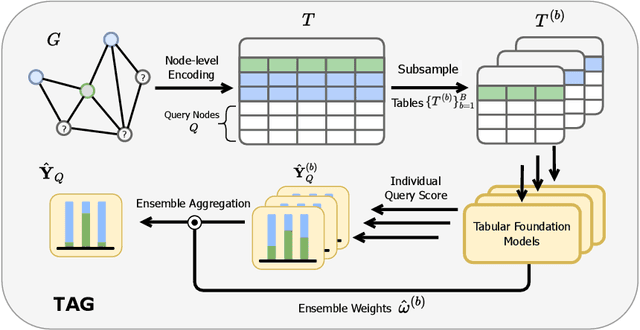
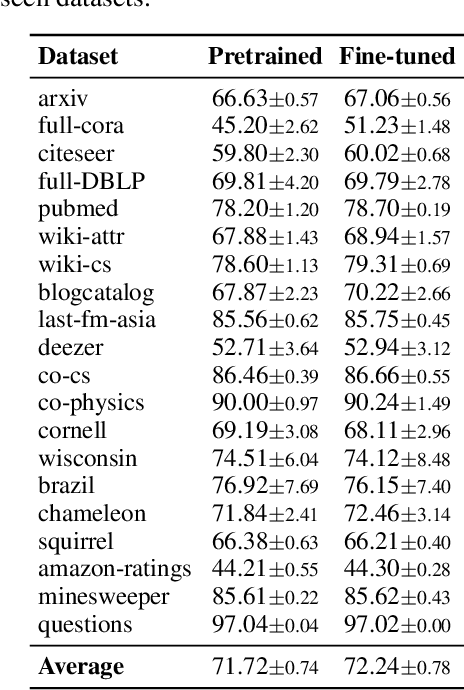
Graph foundation models (GFMs) have recently emerged as a promising paradigm for achieving broad generalization across various graph data. However, existing GFMs are often trained on datasets that were shown to poorly represent real-world graphs, limiting their generalization performance. In contrast, tabular foundation models (TFMs) not only excel at classical tabular prediction tasks but have also shown strong applicability in other domains such as time series forecasting, natural language processing, and computer vision. Motivated by this, we take an alternative view to the standard perspective of GFMs and reformulate node classification as a tabular problem. Each node can be represented as a row with feature, structure, and label information as columns, enabling TFMs to directly perform zero-shot node classification via in-context learning. In this work, we introduce TabGFM, a graph foundation model framework that first converts a graph into a table via feature and structural encoders, applies multiple TFMs to diversely subsampled tables, and then aggregates their outputs through ensemble selection. Through experiments on 28 real-world datasets, TabGFM achieves consistent improvements over task-specific GNNs and state-of-the-art GFMs, highlighting the potential of tabular reformulation for scalable and generalizable graph learning.
Equivariance Everywhere All At Once: A Recipe for Graph Foundation Models
Jun 17, 2025Graph machine learning architectures are typically tailored to specific tasks on specific datasets, which hinders their broader applicability. This has led to a new quest in graph machine learning: how to build graph foundation models capable of generalizing across arbitrary graphs and features? In this work, we present a recipe for designing graph foundation models for node-level tasks from first principles. The key ingredient underpinning our study is a systematic investigation of the symmetries that a graph foundation model must respect. In a nutshell, we argue that label permutation-equivariance alongside feature permutation-invariance are necessary in addition to the common node permutation-equivariance on each local neighborhood of the graph. To this end, we first characterize the space of linear transformations that are equivariant to permutations of nodes and labels, and invariant to permutations of features. We then prove that the resulting network is a universal approximator on multisets that respect the aforementioned symmetries. Our recipe uses such layers on the multiset of features induced by the local neighborhood of the graph to obtain a class of graph foundation models for node property prediction. We validate our approach through extensive experiments on 29 real-world node classification datasets, demonstrating both strong zero-shot empirical performance and consistent improvement as the number of training graphs increases.
HYPER: A Foundation Model for Inductive Link Prediction with Knowledge Hypergraphs
Jun 14, 2025Inductive link prediction with knowledge hypergraphs is the task of predicting missing hyperedges involving completely novel entities (i.e., nodes unseen during training). Existing methods for inductive link prediction with knowledge hypergraphs assume a fixed relational vocabulary and, as a result, cannot generalize to knowledge hypergraphs with novel relation types (i.e., relations unseen during training). Inspired by knowledge graph foundation models, we propose HYPER as a foundation model for link prediction, which can generalize to any knowledge hypergraph, including novel entities and novel relations. Importantly, HYPER can learn and transfer across different relation types of varying arities, by encoding the entities of each hyperedge along with their respective positions in the hyperedge. To evaluate HYPER, we construct 16 new inductive datasets from existing knowledge hypergraphs, covering a diverse range of relation types of varying arities. Empirically, HYPER consistently outperforms all existing methods in both node-only and node-and-relation inductive settings, showing strong generalization to unseen, higher-arity relational structures.
How Expressive are Knowledge Graph Foundation Models?
Feb 18, 2025Knowledge Graph Foundation Models (KGFMs) are at the frontier for deep learning on knowledge graphs (KGs), as they can generalize to completely novel knowledge graphs with different relational vocabularies. Despite their empirical success, our theoretical understanding of KGFMs remains very limited. In this paper, we conduct a rigorous study of the expressive power of KGFMs. Specifically, we show that the expressive power of KGFMs directly depends on the motifs that are used to learn the relation representations. We then observe that the most typical motifs used in the existing literature are binary, as the representations are learned based on how pairs of relations interact, which limits the model's expressiveness. As part of our study, we design more expressive KGFMs using richer motifs, which necessitate learning relation representations based on, e.g., how triples of relations interact with each other. Finally, we empirically validate our theoretical findings, showing that the use of richer motifs results in better performance on a wide range of datasets drawn from different domains.
Homomorphism Counts as Structural Encodings for Graph Learning
Oct 24, 2024Graph Transformers are popular neural networks that extend the well-known Transformer architecture to the graph domain. These architectures operate by applying self-attention on graph nodes and incorporating graph structure through the use of positional encodings (e.g., Laplacian positional encoding) or structural encodings (e.g., random-walk structural encoding). The quality of such encodings is critical, since they provide the necessary $\textit{graph inductive biases}$ to condition the model on graph structure. In this work, we propose $\textit{motif structural encoding}$ (MoSE) as a flexible and powerful structural encoding framework based on counting graph homomorphisms. Theoretically, we compare the expressive power of MoSE to random-walk structural encoding and relate both encodings to the expressive power of standard message passing neural networks. Empirically, we observe that MoSE outperforms other well-known positional and structural encodings across a range of architectures, and it achieves state-of-the-art performance on widely studied molecular property prediction datasets.